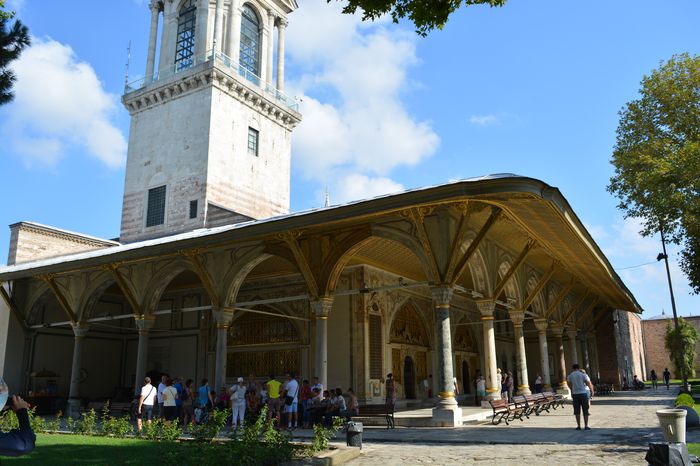
Guided by his unusual interpretation of Sozomen’s account, Gyllius began a determined effort to identify the exact location of the Hebdomon. He was an energetic and careful explorer of the ancient remains of Constantinople, but in this case his investigations were shaped from the start by a faulty assumption. Because he believed that the Hebdomon lay only one mile from the city, he measured that distance not from the later Walls of Theodosius, but from the older Wall of Constantine. The suburb, he argued, must have existed before the Theodosian Walls were built and therefore could not have been measured from them Tekfour Serai and the Palace Question.
According to this reasoning, the one-mile distance would place the Hebdomon somewhere near the later fortifications of the city. This conclusion led Gyllius to search the areas close to the Theodosian Walls for further evidence that might support his theory.
Discovery of a Church on the Sixth Hill
While pursuing this line of inquiry, Gyllius discovered the ruins of a large and impressive church dedicated to St. John the Baptist. These remains were located on the Sixth Hill of Constantinople, near Bogdan Serai and Kesme Kaya. The discovery seemed promising, because historical sources clearly state that the Hebdomon was adorned with a church dedicated to St. John the Baptist Sofia Daily Tour.
This coincidence strongly influenced Gyllius. Instead of questioning whether more than one church might have been dedicated to the same saint, he quickly concluded that the church ruins he had found must belong to the Hebdomon itself. From this assumption, he asserted that the Hebdomon was located on the Sixth Hill, which by his own time lay within the city walls.
He expressed this conclusion confidently in Latin, stating that the suburb called Hebdomon had stood on the Sixth Hill, now inside the city, and that this was proven by the church of St. John the Baptist, which the Greeks still commonly called the church of the Forerunner.
The Problem of the Name “Hebdomon”
Having placed the Hebdomon only one mile from the city, Gyllius now faced a serious difficulty. The very name “Hebdomon” means “the seventh,” and in Roman and Byzantine usage such names almost always referred to distance markers, especially milestones. If the suburb was only one mile from the city, why would it be called “the Seventh”?
To solve this problem, Gyllius proposed another explanation. He suggested that the land outside the Wall of Constantine had once been divided into a series of suburban districts, each named by a numeral. According to this theory, the Hebdomon was simply the seventh suburb in that sequence, not a place seven miles away.
Supporting Evidence and Its Limits
To support his idea, Gyllius pointed out that Byzantine writers often referred to a district called the Deuteron, meaning “the Second.” This showed, he argued, that numbered suburban names were indeed used. He might also have added that other districts were known as the Triton (“the Third”) and the Pempton (“the Fifth”).
However, these examples do not prove his case. Such names do not necessarily refer to suburbs arranged in a continuous series near the city walls. More importantly, they do not override the clear statement of Sozomen that the Hebdomon lay at the seventh milestone.
Gyllius’ identification of the Hebdomon on the Sixth Hill rests on a chain of assumptions rather than firm evidence. Each step in his reasoning depends on the acceptance of the previous one. Once his original interpretation of Sozomen is rejected, the entire structure collapses. The presence of a church dedicated to St. John the Baptist is not enough to relocate the Hebdomon, especially when stronger historical and geographical evidence points elsewhere.