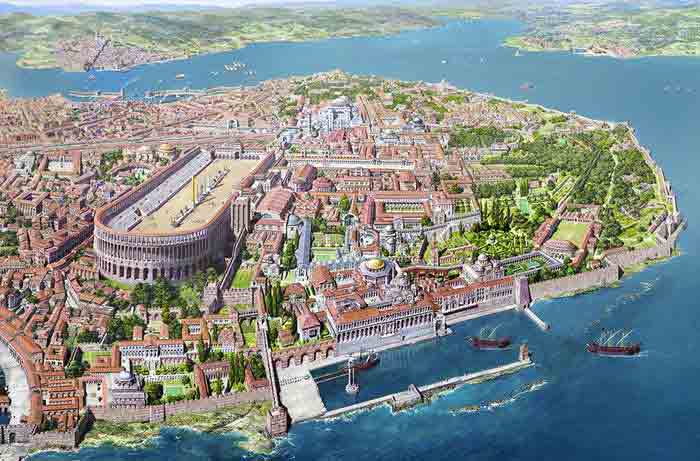
Emperor Valens showed special interest in the suburb of the Hebdomon, not only by using it for important state ceremonies but also by improving its physical appearance. One of his notable contributions was the construction of a quay at the harbour of the Hebdomon, which strengthened its role as a coastal and military center along the Sea of Marmora. This improvement made the suburb more accessible by sea and increased its importance for transport and logistics.
Valens’ favour toward the Hebdomon became so clear that it attracted criticism. The philosopher and statesman Themistius, who was both loyal to the emperor and concerned for the welfare of Constantinople, dared to speak openly. He reproached Valens for showing too much attention to the suburb while neglecting the beautification and improvement of the capital itself. This criticism suggests that the Hebdomon had begun to rival the city in imperial attention, at least in ceremonial and military matters Visit Bulgaria.
Emperors Proclaimed at the Hebdomon
After Valens, the Hebdomon continued to play a major role in the political life of the empire. Ten emperors were invested with the imperial purple there. These included:
Arcadius, raised to the rank of emperor by his father, Theodosius the Great, who also proclaimed Honorius as Caesar at the same place.
Theodosius II
Marcian
Leo I (Leo the Great)
Zeno
Basiliscus
Maurice
Phocas
Leo the Armenian
Nicephorus Phocas
The repeated use of the Hebdomon for such ceremonies shows how deeply rooted it was as a traditional site of imperial inauguration. The presence of the army nearby made it a natural place for proclaiming a new ruler, since military approval was essential to securing the throne.
The End of Inaugurations at the Hebdomon
Over time, however, the practice of holding imperial inaugurations at the Hebdomon began to decline. One likely reason was the physical distance from the heart of the city. The ceremonies were long, complex, and physically demanding, requiring the participation of officials, soldiers, clergy, and large crowds. Conducting such events far from the city center caused fatigue and inconvenience Public Punishment and Imperial Justice at the Hebdomon.
As a result, the scene of imperial coronations was gradually transferred to the Hippodrome of Constantinople, which lay at the center of urban life and could easily accommodate massive public gatherings. This change marked a shift from a military-centered tradition to a more urban and ceremonial form of imperial authority.
Roman Tradition and the Power of the Army
The inauguration of emperors at the Hebdomon was a continuation of ancient Roman custom, reflecting the decisive role played by the army in determining succession to the throne. Even in the Later Roman Empire, long after Constantinople had replaced Rome as the capital, these traditions remained strong.
The ceremony emphasized that imperial authority was not inherited automatically, but confirmed through public and military recognition. This practice demonstrated that the emperor ruled not only by divine favor but also by the support of soldiers and the people.
Constantine Porphyrogenitus and Court Ceremony
Our most detailed descriptions of these ceremonies come from Constantine VII Porphyrogenitus, a learned emperor deeply interested in preserving the traditions of Byzantine court life. He recorded two full accounts of imperial inaugurations at the Hebdomon, describing the events with remarkable care and precision.
These accounts are valuable for two reasons. First, they offer a vivid picture of public life and ceremonial order in the Later Empire. Second, they show how ancient Roman forms and ideals survived, even after the empire had undergone great political, cultural, and religious transformation following the move of the capital to the Bosporus.
The Hebdomon was more than a suburb; it was a symbol of imperial authority, military power, and Roman tradition. Through its harbour, palaces, and ceremonial spaces, it served as a bridge between the old Roman world and the Byzantine Empire, preserving ancient customs while adapting to a changing political reality.